
Almost 10 years ago I started learning the beautiful Greek language. Almost every day (I study 5 days a week) I learn a little bit more.
I’ve experimented with many tools, online as well as offline. And of course most of them were useless. I’m happy to share which tools and routines have stuck for years now. You can use my “system” for any language you want to learn.
Tool: RemNote
Many years ago I learned about Remnote via Swiss friend Roman‘s former blog and it’s been the tool of the century for me.
RemNote is a very versatile note-taking and knowledge management tool. It’s basically a blank canvas that you fill with flashcards in whatever way you like. I mostly use very simple flashcards with pictures (here’s 1 with “tools”), and clozes (“fill in the word”), but the sky is the limit…
Central to RemNote is the built-in spaced repetition, a learning technique where you review information at increasing time intervals to strengthen long-term memory, working against the natural forgetting curve by scheduling reviews just before you’re likely to forget, making it far more efficient than cramming.
RemNote is extremely fast no matter how many flashcards you have (one of my documents has 2300 words & pictures). It works 100% offline and synchronises blazingly fast on all platforms. And it’s free, although you can pay for very useful AI tools & more.
Sign up for Remnote via this link & get a free paid account for a month.
Tool: ChatGPT
I hate wasting time reading about (or listening to) things that are un-interesting, and to be honest: there’s a lot of shit Greek language content available online. Especially for people who aren’t fluent, there’s really little.
So I started creating my own content, using ChatGTP’s super-useful “Projects” function where I added some very detailed instructions that make ChatGPT create a 300 word story in level B2 Greek ncluding a list of interesting words If I just type “B2: [topic]”.
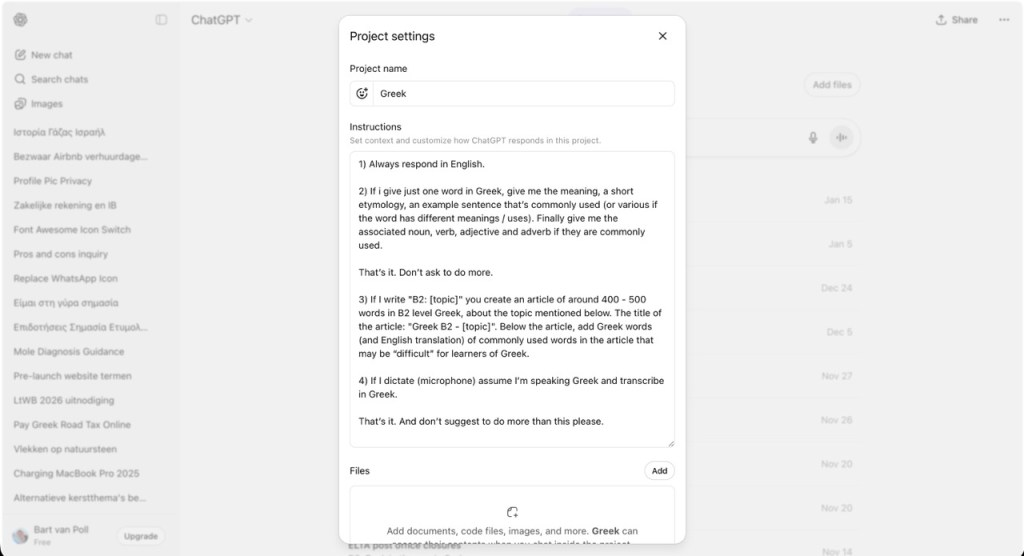
Every Friday, I create 5 stories (one for every day I’m learning in the next week) about topics I want to know more about. And with a custom-built tool (Notion / Python) I upload them to my eReader in 2 clicks for comfortable reading without distractions. Next step: a workflow without ChatGTP.
Here’s a list of some of the B2 Greek stories I (or rather: ChatGTP) created.
My current project: writing a book in B2 level Greek with an AI (not ChatGTP) about a person (Bart) who travels to all the capitals in the world. One chapter for each capital. This isn’t easy as LLM’s don’t have the attention span to write so many words. It should be possible with a bit of programming and n8n.
Tool: iTalki
Talking is key, and for me it’s much more important than being able to write correctly. I’ve been doing at least 1, but usually 2 video conversations per week for the past 10 years. I have a few “fixed” teachers that I have been regularly talking to for years (like my friend Sakis below), but I also love regularly talking to a random new teacher I haven’t met before.
I’ve tried a few different platforms. Preply is good, but I’ve stuck with iTalki as they have most teachers. A 45 minute conversation lesson costs between US$8 and US$15. There’s also professional teachers, who can charge considerably more for a good reason.
Get US$5 free when you sign up via this link.
Routine routine routine
The following tasks are in my project management system Asana, and I have 45 minutes blocked in my calendar before I start every workday .
- Every morning: learn words (RemNote flashcards) and listen / watch / read something.
- Once a week (every Friday morning), I:
- create 5 new stories to read
- fill my “favorites” playlist in my podcast player and Youtube “play later” list with a week full of good content
- check the history on my translation app (Deepl), my paper notebook and my digital notes (Notion) for useful words and add flashcards in RemNote
Great sources for Greek learners
Video
- Easy Greek – the best produced videos – with Greek “from the streets”. If you support them you get loads of really useful goodies like exercises and transcripts. Disclaimer: Marilena & Dimitris are friends (and clients), but it’s all true!
- Vice Greece (sadly no longer updated)
- Glossonauts – high quality video & funny
- Negros Tou Moria – my favorite Greek rapper
Audio
- Gen Z(εν) – stay up-date with Gen-Z topics
- Αβολο podcast – “uncomfortable” topics
- Ράδιο <<Κ>> – newspaper Kathimerini’s podcasst
- INFOWAR – impressively in-depth researched topics
- EasyGreek – they have a good podcast too
- Explainer (Σταύρος Δυσκουρίδης) – interesting topics
- six thousand islands – not frequently updated, but simple & fun
Reading
For B1/B2 level learners I recommend going to second hand bookstores and asking for books for teens / young adults (and if you’re as old as I am and ashamed: tell them it’s for your son/daughter). This level is just right for me.
Also Μέγας Αλέξανδρος (Alexander the Great) by Νίκος Καζαντζάκης (Nikos Kazantzakis) is a very readable classic!
This article contains a few affiliate links. If you sign up to one of these services that I love, you and I will both get some goodies. Of course it doesn’t costs you any extra.
